

Satellaview - An Explainer
Published on 23 Jan 2026
 Ce post existe en Français en cliquant sur ce texte.
This post is about explaining what the Satellaview is to people who don’t know anything about it. Sometimes, reading a Wikipedia page doesn’t quite give an easy way to understand what it was.
Think of this post as just merely the tip of the iceberg, to at least give an answer to a simple curiosity.
The Quick Explainer
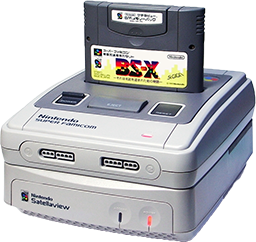 The Satellaview is an add-on for the Super Famicom (japanese Super NES) that launched only in Japan in April 1995 as a collaboration between Nintendo and St. GIGA, and a way to sum it up is like this:
Think of it as a way to access some kind of playable Super NES TV channel where you can receive games and digital magazines at specific timeslots while also listening to live radio programs, FOR FREE.
There were exclusive games on it made by Nintendo but also sometimes by major third parties like Squaresoft and more. There were Mario, Zelda, Kirby games, and also new IPs at times.
Contrary to popular belief, the Satellaview service was free to use, its broadcaster, St. GIGA, had their own subscription service but it was really just for their own service specifically and not the Satellaview service which they did host for free. But you do have to consider that you still needed a satellite tuner and antenna to use it, and in 1995, let’s say it was expensive to get.
And since it was satellite in the 90s, this was not really online gaming, Internet was not in use, that was too new at the time. There was no multiplayer aspect to it, because the game data and radio audio were only streamed one way from the satellite to your console, and you couldn’t beam back at it to tell for example where you are in a game to other players. It’s not too different from what the Sega Channel did with cable.
What You Do With It
The Satellaview system is made of:
- A receiver (called Satellaview) that you put under the console that you would plug to the satellite tuner.
- A special cartridge (called BS-X) that contains the software to access the service.
- This special cartridge also contains a slot for a 8Mbit (1 MByte) Memory Pack cartridge which acts as storage.
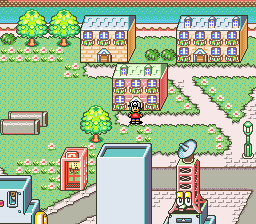 When you use BS-X, you have a sort of RPG looking menu system where you choose between a boy or a girl and then you roam around a small town with lore (of which unfortunately, is not really solvable), where you can access several programs, which ranges from a wide variety of stuff that can be either rereleases or exclusive content usually downloaded to your Memory Pack storage:
- Regular Super Famicom games
- Usually the exact same as the cartridge release, usually a demo with limited amounts of startups.
- Digital Magazines
- Actually can range from a wide variety of stuff, can also be just comics, talking about all sorts of stuff like cooking too.
- Exclusive Satellaview Games / Versions
- The kind that you can usually download to your storage and play anytime you want.
- Sometimes it can be different versions of games that already existed with exclusive content or maybe just a special competition version.
- Exclusive Soundlink Satellaview Games
- Soundlink means games that uses the live radio as part of the game experience, think of fully voiced stories and CD quality music that you can listen to as you play the game.
- It is usually episodic, and could only be played at its specific timeslot because of the live audio.
- Downloadable Content for Compatible Games
- Some other Super Famicom games came out with the same kind of cartridge as BS-X, where you can also put a Memory Pack storage on them, so sometimes, there were DLCs for them!
Keep in mind that to get them, you had to be there at a specific timeslot so you can receive the data, think of it like watching a TV show, on TV channels that have their programming of shows. Many people could basically play the same game at the same time, though without any real multiplayer possible because of how the technology works.
The Games
I’m not gonna waste any time, you probably want to know more about the games, so let’s talk about them.
Soundlink Games
As previously explained, these games make use of the live radio audio as part of the experience, and therefore, these games could only be played during their alloted time, as the live audio does not have a way to stop.
And in case you would find this unfair, keep in mind this was a technical limitation of satellite broadcasting, you couldn’t fit an entire hour of live audio into the game, it would have made the data way too big to fit, we’re not using CDs here, just cheaper technology. And unfortunately, the developers did not really show interest in having versions that you could play any time, save for one specific game where they did bother.
A lot of those games would have BS in the title, which you can laugh all you want, but it actually means “Broadcast Satellite,” but in Japan, think of it as a general catch-all term that describes that it is related to satellite broadcasting.
Here’s a curated list of those games, I apologize that the descriptions are huge, but really I want to hammer home how Satellaview is unusual, and I’m really trying my best to sum those games up in terms of context and gameplay, but many times those games have been poorly explained without anyone correcting them. I want to give them the attention they deserve.
BS Legend of Zelda
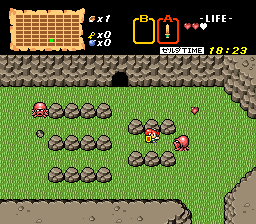 This was the first soundlink game of the service. It is usually summed up as a Zelda 1 SNES remake, but it deviates from the original in a bunch of ways.
The most obvious one is that it is played alongside a fully voiced audio track with some high quality arranged music, with the old man from the cave at the start of the game giving you hints to secrets or how to advance, and sometimes uses his magic powers at specific times to provide you help like defeating all enemies on the screen or giving infinite bombs for a limited time. Sometimes timed events would happen where you can miss some items if you are not fast enough. You also do not play as Link, you are the BS-X character you have chosen as either a boy or a girl instead.
This was the first soundlink game of the service. It is usually summed up as a Zelda 1 SNES remake, but it deviates from the original in a bunch of ways.
The most obvious one is that it is played alongside a fully voiced audio track with some high quality arranged music, with the old man from the cave at the start of the game giving you hints to secrets or how to advance, and sometimes uses his magic powers at specific times to provide you help like defeating all enemies on the screen or giving infinite bombs for a limited time. Sometimes timed events would happen where you can miss some items if you are not fast enough. You also do not play as Link, you are the BS-X character you have chosen as either a boy or a girl instead.
The game has been broadcasted in 4 episodes of 1 hour each, initially starting on a limited region of the map and expanding over the episodes. Each episode also gives you objectives: items and triforce pieces that you are expected to get by the end of the episode. If you miss out, you have to make up for it in future episodes, which can feel really unfair.
Because of how it is overall a 4 hour episodic experience, the game is more of an abridged version of Zelda 1, the main map is smaller, but all the dungeons have completely different layouts. It also has more of a focus on score, which is unusual to Zelda games, which at the end you send a password to Nintendo with a postcard to receive prizes if you did well. It is actually possible to have a bad ending if you are taking too long to reach and beat Ganon. There is also a second version of the game with a different map layout called MAP 2.
If you want to play this game, I recommend the MSU1 hack which provides the closest experience to the original. You may have already seen some hacks of this on YouTube like the “Third Quest” version, but really keep in mind that it’s not always the originally intended experience by Nintendo.
Video of the first episode in japanese, recorded from back in the day.
BS Legend of Zelda - Ancient Stone Tablets
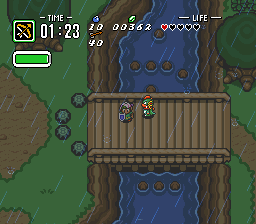 This is the other Zelda exclusive title, this time based on A Link To The Past, and is actually a sequel (that isn’t canon, but still), as once again playing the BS-X character instead of Link. It’s once again fully voiced, but this time around the story is more involved, with more characters having an active role upon the unfolding story as you progress through the dungeons for ancient stone tablets.
Once again broadcasted in 4 episodes of 1 hour each, each episode focuses on a specific region of the map, once again giving objectives for each episode like the previous game, but this time around, if you missed out on objectives, later episodes would just have a thief in front of dungeons that weren’t finished in time, to just directly give you every single important item you missed in it, including the stone tablets. This is clearly in attempt to make the game easier and fairer, but also acts as a way to make the player focus more on what the current episode is about than the previous ones.
Unlike the previous BS Zelda game, this is a more balanced game that doesn’t want to let you fall behind, the scoring aspect makes a comeback with even more secrets to uncover, and all dungeons are completely remixed compared to A Link To The Past. The events of the story also has more importance into the gameplay, as for example you could suddenly have the game to rain, making Zoras come out aggressively and preventing you to use bombs outside, or sometimes, you might have to save a character in sudden need of help.
The game also adds the Rental Shops, where you can rent more powerful items for a specific amount of time. This is a concept that would be revisited in A Link Between Worlds on Nintendo 3DS!
I also want to give a shoutout to the fans who have worked painstakingly to restore the game to a playable state. Definitely don’t assume Satellaview archival to be easy, we also easily come up with games that are dysfunctional as we get ROMs of them and require a ton of work to sometimes remake entirely missing data. I also recommend the MSU1 hack to have the closest experience as intended by Nintendo.
Video of the first episode in japanese, recorded from back in the day.
Excitebike Bunbun Mario Battle
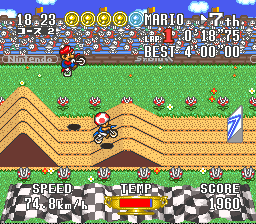 This is indeed a brand new Excitebike game on the Super NES, where you can now play as Mario characters!
Also using live radio for comments and hints, this is not the most interesting use of that feature, but it’s still fun to have high quality music while playing it!
This is indeed a brand new Excitebike game on the Super NES, where you can now play as Mario characters!
Also using live radio for comments and hints, this is not the most interesting use of that feature, but it’s still fun to have high quality music while playing it!
This is also a 4 episode game, where the format is simple for each: 4 courses, first starting with a time attack mode on your own so you can get familiar with the course, then playing against opponents. In between courses you will also play some minigames, like one where you try to jump as far as you can, or one taken straight from VS. Excitebike where you try to jump over Boos in an obstacle course, then it ends with a final score and password to send to Nintendo for prizes.
There is a new feature where if you collect 5 coins (which you can also collect by crashing your opponents), you can go into SUPER mode where you can’t overheat your engine and allow you to speed up as much as you want. But don’t underestimate this game: you still need to watch out about your opponents and the course itself, because if you crash, the SUPER mode is gone.
Video of the first episode in japanese, recorded from back in the day.
BS Shin Onigashima
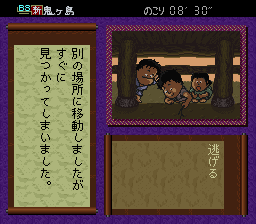 This is a 4 episode side-story / sequel / remake to one of Nintendo’s Japan only text adventure games.
It follows the three animals companions in each episode, before they met Donbe and Hikari, the main characters of the original game, and expands on some of the events that unfolded. The fourth episode is a remake of the final two chapters of the original Famicom Disk System game.
This is a 4 episode side-story / sequel / remake to one of Nintendo’s Japan only text adventure games.
It follows the three animals companions in each episode, before they met Donbe and Hikari, the main characters of the original game, and expands on some of the events that unfolded. The fourth episode is a remake of the final two chapters of the original Famicom Disk System game.
It has way more of a focus on story as a result of how the game is, all narrated live with sometimes clues given to the player, and is more like made of sections where the player has to figure out how to solve everything within a specific amount of time, with some minigames in between.
It is kind of considered as a game that didn’t give a lot of player agency and its side story nature described to be not as exciting as the original game, but I felt it was interesting to mention it as this is the only Soundlink game that got ported to a regular cartridge format later on, making it the only game that was kept playable in some form past the limitations of the Satellaview by the developers, at least at the time.
If you want more information about this game, I highly recommend the Hardcore Gaming 101 page about BS Shin Onigashima.
Video of the first episode in japanese, recorded from back in the day.
BS Marvelous - Time Athletic & BS Marvelous - Camp Arnold
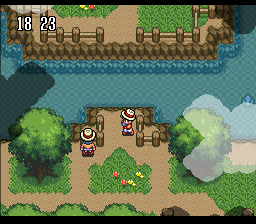 Two prequels to a Japan only game called Marvelous ~Another Treasure Island~, known to be the first game that Eiji Aonuma directed, right before he worked on Ocarina of Time and becoming the producer of all Zelda games later.
Imagine if A Link To The Past was a bit more puzzle focused with a pinch of point ‘n click, where you control 3 kids with different abilities, and that’s basically what Marvelous is, showing how Aonuma was just truly a fan of Zelda but somehow made a game that didn’t use that franchise. It’s actually a pretty charming game that shouldn’t be ignored!
Both prequels happen during summer camps on remote islands with a full class of kids accompanied by their teacher, with a stamp rally, quests to solve while racking up Luck Rocks for score, and because of its Soundlink nature, is fully voiced, usually by your in-game teacher guiding you. It is definitely more gameplay and puzzle focused than story, but it doesn’t come without charm.
Video of the first episode of Time Athletic in japanese, recorded from back in the day.
BS Detective Club - The Past that Disappeared in the Snow
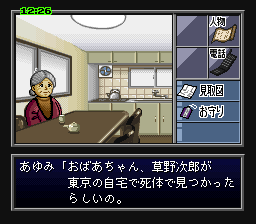 The actual third game in the series of Famicom Detective Club, and unlike what Nintendo said, this game had Ayumi Tachibana as the main playable protagonist for the first time, in fact, the male protagonist does not even show up at all here! This follows Ayumi in the snowy village of Ochitani, and follows with, as usual, an investigation into a murder case that presents a deeper story that might tie Ayumi’s family more than she would have thought.
This is a 3 episode story, mostly comprised of a voice acted narration that would progress no matter what you do, while having sections in-between where you are free to act, and uncover as much as you can of the details of the story. The game would then tell you a percentage of how much you have uncovered.
This shows more of the limitations of Soundlink games, where being dependent on the live audio, and therefore on time, could be a detriment to the game, as you could simply miss story elements if you’re taking too much time. And since this is a 3 hour game in total, you can consider that making a remake of this game might not be worth it without a significant redesign of the game and story.
Ayumi’s voice actress (Yuko Minaguchi) would actually reprise her role for the Switch remakes and sequel, showing that somehow Nintendo can have a bit of care about Satellaview, while somehow forgetting that Ayumi was actually playable in her own game.
If you want to know a bit more, feel free to read Hardcore Gaming 101’s page about the game here.
Video of the first part in japanese, recorded from back in the day.
Waiwai de Q / Satella-Q
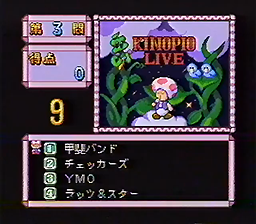 Quite possibly the kind of game that makes the most sense for the Satellaview to have while synchronized to a live radio: A quiz show with a live presenter telling you the questions! Toad usually shows up as the mascot as you play.
It’s a quiz show with different sections with different rules, for example one where you answer questions with either Yes or No in quick succession, one where you actually type words to answer, and of course, good old multiple choice questions, either based on scrambled images, or a blind test (where you see an animated Toad singing). And then in the middle of it, a little action minigame starring Toad on some sort of billiard table where you have to pick up colored balls in a specific order as they quickly roll around the board.
Unfortunately, these games cannot be preserved as the data is actually never served to the Memory Pack, and the only traces of them we will ever have are recorded videos of them.
Video of one of the episodes in japanese, recorded from back in the day.
BS F-Zero Grand Prix 2
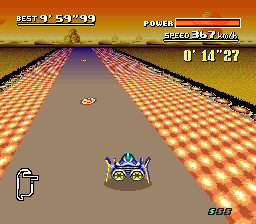 BS F-Zero Grand Prix 2 is an adaptation of F-Zero for Soundlink, with brand new courses and especially brand new machines to play with different stats.
This had 2 episodes, this is structured with 5 courses for each episode, where you first begin with a small explanation of the course, then a time attack section for a limited time for training, and then a proper race with opponents, all with sometimes crazy live narration and comments explaining how to play the game, with copyrighted rock music, remixes of F-Zero music and original music!
This is the sequel to BS F-Zero Grand Prix which is similarly structured with 4 episodes comprised of the original F-Zero courses + 1 brand new course for each episode, these 4 new courses were all reused in Grand Prix 2, with 6 brand new ones on top. BS F-Zero Grand Prix 2 had a downloadable practice version with those 4 new courses from Grand Prix 1 + a new one and that was actually all we had to play with for a long period of time.
F-Zero 99 was updated with those 5 courses from Practice as well as including cleaned up skins of those new machines (without their unique stats), setting a very interesting precedent for Satellaview content from Nintendo. Hopefully they would add the other 5 new courses in the future.
Fans would figure out how to reproduce the 5 other circuits from Grand Prix 2 in BS F-Zero Deluxe, an ultimate ROM hack that includes everything from every SNES F-Zero game. We preserved the original data of 2 of those circuits very recently as we finally found the first episode of Grand Prix 2.
Video of the first episode in japanese, recorded from back in the day.
BS Fire Emblem: Archanea Saga
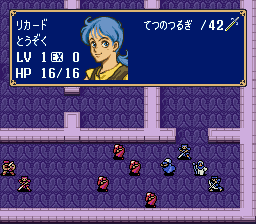 This is a 4 episode saga set before the events of the first Fire Emblem.
It has a brand new set of maps with a new story with a focus on a different cast of characters outside of Marth, with minimal dialogue and no battle animations, mostly to fit in the live voice acting that dictate the story and brand new music arrangements. The gameplay tends to be more about surviving the entire hour of the episode, there are no set goals for victory beyond that.
The developers used to count this game as the 5th game in the series at one point, though it is unsure now, but the Legacy of Archanea book included in the collector’s edition of Fire Emblem: Shadow Dragon & the Blade of Light does reference this game with summaries and contains definitely localized names of each chapter, in the sense that it is not a direct translation. It’s not impossible to consider that internally, this game’s script has been fully localized at a point in time, as we know that they had to localize all of the Japan only games for the needs of the mobile game Fire Emblem Heroes.
This is the only Soundlink game that had a remake as bonus content through the Japan only Nintendo DS remake New Mystery of the Emblem, though made in mind with the DS game’s engine and removing many of the unique aspects of the original Satellaview version.
Video of the first episode in japanese, recorded from back in the day.
SatellaWalker / SatellaWalker 2
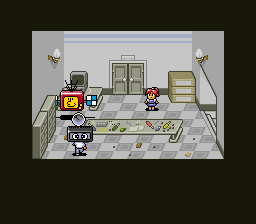 These were little episodic games set in the world of BS-X.
As BS-X was pretty limited in scope, it was huge to play a version of it that let you go inside buildings and talk to NPCs. It had a comical overarching story, but it had more of a focus on errands outside that, as the big events would be forced to the player directly. It actually references everything that happened during the service, each broadcast that occured are canon, and sometimes the game challenged your knowledge of them!
Video of the second episode of SatellaWalker 2 in japanese, recorded from back in the day.
Kodomo Chousadan Mighty Pockets
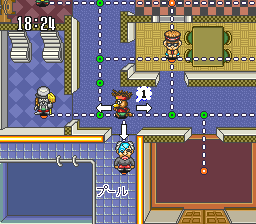 Set in a universe of anthropomorphic animals with a huge focus on Hip-Hop and Rap music played on the live radio, this is actually a board game directly in the style of Clue, where you investigate murders, and figure out who did it, with what weapon and where, on a board where progression across rooms is done using a die.
It is by far the most experimental game that I’ve seen from Nintendo, and you would have tons and tons of copyrighted hip-hop and rap music playing from across the world… and sometimes it has so much of a political message that I wonder if Nintendo & St. GIGA ever checked the lyrics. Like, one of those songs is a french rap that explains colonisation and racism and outright says the N-word to explain it.
It had 3 episodes, and the third episode was the final new content created by Nintendo before pulling out from the Satellaview service in 1999, leaving St. GIGA alone to manage it with reruns until June 2000, where the service was closed.
Video of the first episode in japanese, recorded from back in the day.
Standalone Games
All previous games mentioned so far were Soundlink games, all games that used the live radio in one way or another as part of the experience.
We’re now talking about standalone games, not using the live radio, so essentially games that don’t really act much different from regular Super NES cartridge titles. There were exclusive games too, and again, I’m gonna curate the list to the exclusives that I recommend.
Special Tee Shot
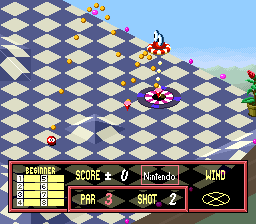 If you think this game looks similar to Kirby’s Dream Course, this is normal.
This game was originally announced in 1992, but then Nintendo & HAL Laboratory decided to transform it into a Kirby mini-golf game using the same engine.
If you think this game looks similar to Kirby’s Dream Course, this is normal.
This game was originally announced in 1992, but then Nintendo & HAL Laboratory decided to transform it into a Kirby mini-golf game using the same engine.
But the development of the original game was completed, and it finally made it to Satellaview in 1996, and it is essentially Kirby’s Dream Course without the Kirby, but make no mistake, it is a pretty different game as a result, focused way more on classic mini-golfing on obstacle courses and swinging the ball to the hole with the least amount of shots. It is a game I would still recommend to play, but keep in mind that it is pretty dang hard to complete, unlocking the Gold Course is no easy feat without rewind.
Sutte Hakkun
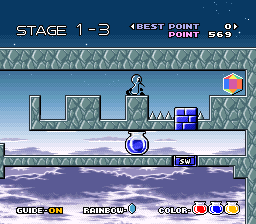 Sutte Hakkun is a game with a pretty interesting development history to talk about, but all I’m gonna say is that its public debut was on Satellaview!
It’s a puzzle platformer game where Hakkun can suck in boxes and magic paint and back to solve puzzles to reach the rainbow crystals in each stage. It gets pretty intense, and it was a pretty popular Satellaview game, where it eventually released as a cartridge game later. This is the version that usually gets rereleased.
But the cartridge version does not reuse all content from the Satellaview versions, like timed challenge stages, or the brand new content of the Winter 98 version with brand new levels. The screenshot is taken from this version.
Don’t miss out on this game if you want some puzzle action.
Waiwai Check
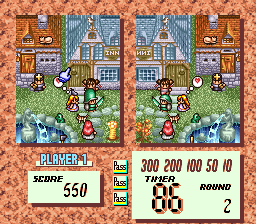 This is basically a spot the difference game, which had multiple weekly versions with different stages. The differences can get pretty humorous at times, and while it’s not a huge game, I think it deserves a bit of a mention, it’s among the Satellaview games that are clearly in the range of being basically a good simple time waster.
Tamori no Picross
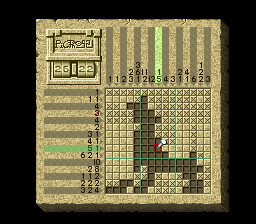 Of course Picross was on Satellaview, and in fact it was there before Mario’s Super Picross released! It was a weekly thing where you could solve different puzzles each week.
And to explain picross to the uninitiated, you make out images by using the numbers on each side, which each number defines as different continuous rows of filled pixels that are on the line or column. It gets pretty addictive once you understand how it works.
Tamori is actually the name of a real personality who was regularly on the Satellaview radio programs.
KONAE-chan no DokiDoki Pengin Kazoku
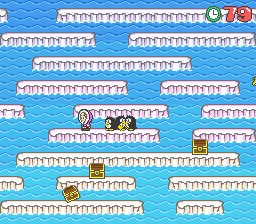 This game is actually a pretty simple game, it is based on real personality Yuuki Nae, who appeared frequently in Satellaview radio programs.
The goal is to cross a huge water river by jumping across rows of glaciers without falling into the water. Treasure chests regularly show up, where you can get items with that gives score points, or get Penguins that follow you. The penguins that follow you tend to be erratic, so you have watch out before you jump or it’s really easy to make all of them fall into the water. The more items and penguins you get at the end of the stage, the more points you get!
Like Waiwai Check, it is a pretty short game, clearly meant as a fun time waster.
Pico Pico Pirates
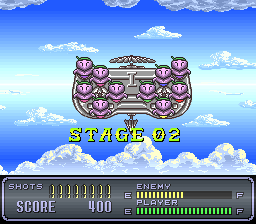 This is also a very short time waster game, it’s just whack-a-mole but on a Super NES controller.
Little pirates with come out from buttons of the reproduced Super NES controller and pressing the corresponding button acts as a gun shot. Later stages eventually get the controller to turn around and the pace gets a lot faster and easier to miss shots. It gets pretty dang hard, I haven’t managed to finish that game!
There’s actually a big mystery surrounding that game: We have actually no idea who made it.
Radical Dreamers - Le Trésor Interdit -
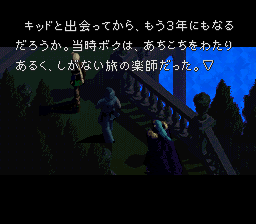 Squaresoft at the time decided to make 4 smaller scope games on the Satellaview, and this is one of them!
This is a text adventure game that follows a group of thieves, composed of Kid, the leader, and Serge and Magil, seeking an artifact capable of granting any wish called the Frozen Flame and seeking revenge on Lord Lynx, the owner of the artifact, by inflitrating his manor on the night of a full moon. It is a pretty dark story, and once completed the first time, it would unlock extremely silly stories when replayed.
Quite a few of the aspects of this game might sound familiar to some, because this game is known to be a sort of draft for what would become Chrono Cross later, by the same writer behind Chrono Trigger.
Square tried to rerelease this game on many occasions, but the writer felt the game wasn’t up to his standards, before eventually finally ceding to what would be finally the first rerelease of this game inside Chrono Cross: The Radical Dreamers Edition, fully translated in several languages! A rare Satellaview rerelease!
Treasure Conflix
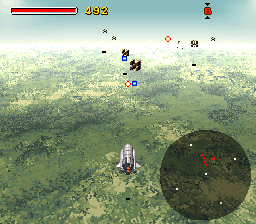 This is another one of those four Squaresoft Satellaview exclusive games.
This time in a futuristic setting, this is about treasure hunters, motivated for the hunt of old civilization artifacts, it’s a game that mixes RPG elements with sequences of Mode 7 shoot ‘em up, and with quite honestly amazing music too.
Figure out where are the treasures, get money, upgrade the parts of your airship to fare yourself better against hostile pirates, it’s a definitely a unique game from Squaresoft.
This game got a fan translation in English and French, so feel free to check it out!
Dynami Tracer
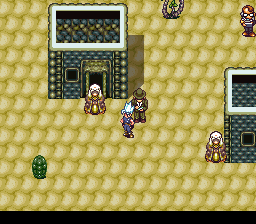 This is another one of those four Squaresoft Satellaview exclusive games, and the last I will talk about here.
It’s another treasure hunting game, but it has nothing to do with Treasure Conflix, in fact, it gets silly. This is racing for getting the most treasures in space as you can, and then get to finish line first.
You can choose a character, and then it starts, and all the other characters will check all the planets available. There is a set amount of treasures, and each player in the race is able to get them, so it’s impossible to get all of them, you just have to improvise and make do with what you can get by talking to NPCs and helping them out.
It’s a game with a lot of humor, and has extremely silly situations, and the game can be extremely short depending on how you play it. You can even reach the finish line from the start if you want, but that won’t really get you to win.
This game also has an English fan translation, so you can enjoy it now!
Cyber Citizen Shockman Zero
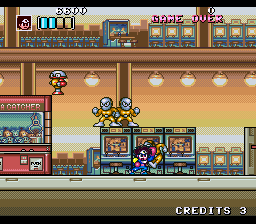 Sometimes, some games get produced for cartridges (for Nintendo, look up SHVC-ASZJ), but then end up on Satellaview instead as a way to release the game with minimal costs.
I’d think this is how Masaya Games, the publisher, might have thought about it.
Sometimes, some games get produced for cartridges (for Nintendo, look up SHVC-ASZJ), but then end up on Satellaview instead as a way to release the game with minimal costs.
I’d think this is how Masaya Games, the publisher, might have thought about it.
This is a “prequel” to the Cyber Citizen Shockman series, a series of games that all released on PC Engine / Turbografx-16 save for this one, it’s a series of platformers that have done pretty different gameplay styles across the games.
This one is a platformer with an arcade beat ‘em up style of gameplay, playing as two new young protagonists that can become androids to fight evil. It is not trying to be original, the story is pretty silly and is like a japanese superhero pastiche, complete with an edgy rival, a crazy scientist and a sexy looking girl.
It is pretty fun to play, and it is the first Satellaview game to have ever received an official rerelease, and it did receive an official English translation for its rerelease on Switch, PS4 and Xbox One.
Golf Daisuki! O.B. Club
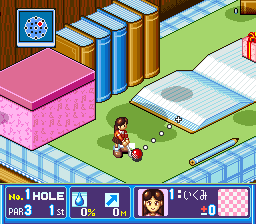 By the same publisher as the previous one, Masaya Games, and probably for the same reason behind its release (for Nintendo, look up SHVC-AOBJ), this is a mini-golf game this time.
The courses are pretty small with some hazards and some stuff to pick up, and you can easily set the way you shoot however you want, this is a game where you can take your time without any timing skills to consider to your shot that might throw you off when you mess up, it can be great for beginners.
It has varied fancy environments, like you can play in a park, on the seaside, on the ruins of a forest, a big toy world, a futuristic cyber world or inside a household where everyday life stuff are bigger.
The game has an English fan translation patch that you can find here..
Kirby’s Toy Box
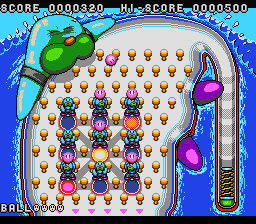
Arrange Ball
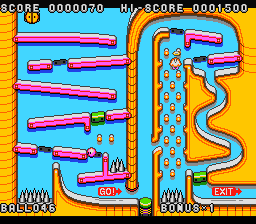
Ball Rally
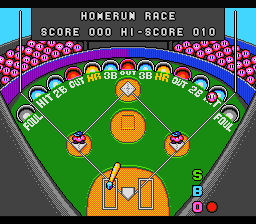
Baseball
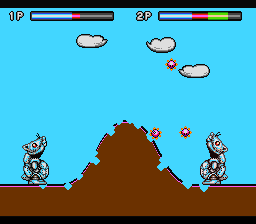
Cannon Ball
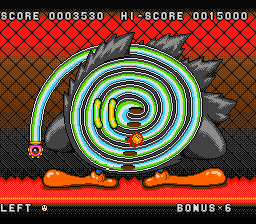
Guruguru Ball
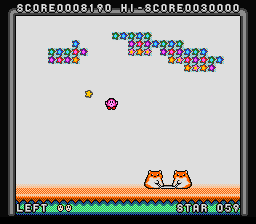
Hoshi Kuzushi
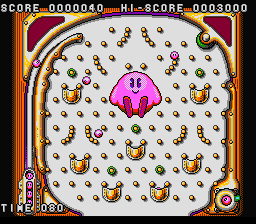
Pachinko
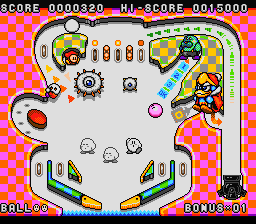
Pinball
I have to mention these minigames, because Kirby somehow got quite a bunch of those on Satellaview. It had 10 minigames, but we do not count 2 of them because they are nothing more than the 2 minigames from Kirby Super Star (Megaton Punch and Samurai Kirby).
Kirby’s Toy Box was made in mind to promote the release of Kirby Super Star in Japan, as every time you start any of them up, you would be greeted with a screen showing the menu of Kirby Super Star to show off the multi game nature of the game.
They made 8 new minigames just for this, and all of them have the theme of having Kirby balls in one way or another, usually very simple games:
- Arrange Ball: Launch 9 balls with varying power to then hopefully complete lines on the 9 holes.
- Ball Rally: Press A to swap platforms and guide all Kirby balls and sometimes King Dedede to the end of the obstacle course.
- Baseball: A very simple mechanical baseball game where you really have to take into account the delay on the swing.
- Cannon Ball: Two Mecha Rick aims and shoots Kirby cannon balls at each other, the balls can actually make holes on the ground.
- Guruguru Ball: Launch 3 Kirby balls as close to the center as possible without applying too much force as the bonus multiplier constantly changes.
- Hoshi Kuzushi: Largely the most complete game of the bunch: A Breakout clone with quite a lot of levels.
- Pachinko: Actually an actual pachinko, where the goal is to make the most points by varying the strength of automatically launching balls.
- Pinball: A much simpler single screen pinball compared to the Game Boy game, but still fun to play with.